Let me ask you something honest.
How many times in the past year has your chainsaw made you regret using it?
The pull-cord that won't start because the chain is too dull to bite the wood properly. The 20-minute job that turned into 90 minutes because each cut required pressing harder and harder. The fuel tank that emptied twice as fast because your engine was working overtime. The kickback scare that reminded you sharp chains aren't just about speed — they're about safety.
If you're like most American chainsaw owners — property owners, homesteaders, farmers, ranchers, hurricane cleanup volunteers, firewood cutters — your answer is probably "more times than I want to admit."
Here's the thing nobody tells you when you buy a chainsaw: the chain dulls within 30-60 hours of cutting. Sometimes much faster if you hit dirt, sand, or a hidden nail. By the time you've owned your chainsaw for a year, it's almost certainly cutting at 30-50% of its original performance — and you've probably adjusted to it without realizing.
Most American chainsaw owners have three terrible options for dealing with this:
Option 1: Hardware Store Trip ($10-25 per chain)
Drive there. Wait. Drive back. Wait for ready. Drive back again. Multiply by 3-4 chains for active properties. Annual cost: $120-450+.
Option 2: Hand-File at Home ($15 kit + 20 hours of skill development)
Use a round file. Try to maintain the exact angle across 60+ teeth. Hope you don't ruin the chain. Most people give up.
Option 3: Buy a Benchtop Electric Grinder ($150-400)
Workbench setup. Extension cord access. Workshop ventilation. Can't use in field. Can't bring to hurricane cleanup sites.
This is exactly where the SawShark Blade Sharpener enters the conversation — and changes everything.
For just $29.99, you get a pocket-sized device that restores chains to factory-sharp condition in 10-15 minutes with 30° factory-spec accuracy, NO chain removal, NO electricity, and NO sharpening skills required. Backed by a 30-Day 100% Money-Back Guarantee and trusted by 90,000+ verified American customers with 94% recommending. Below, I break down every single proven benefit so you know exactly what to expect.
SawShark — Portable Chainsaw Chain Sharpener for American Property Owners, Farmers, Homesteaders & Hurricane Cleanup Volunteers.
What are the main benefits of the SawShark Blade Sharpener?
The SawShark Blade Sharpener delivers genuine 30° factory-spec sharpening accuracy, bar-mounted design eliminating chain removal, hand-crank operation requiring zero electricity, universal compatibility across all major chainsaw brands, heavy-duty aluminum construction for field durability, professional-grade tungsten carbide cutting bit with hundreds of sharpening sessions per bit, massive cost savings versus hardware store services ($1,200-$4,500+ over a decade), 80% time savings vs traditional methods, 30-day risk-free trial, and the practical convenience of professional-grade chainsaw maintenance accessible anywhere — all in a pocket-sized device that fits in your toolbox, truck cab, or emergency kit.
Real 30° factory-spec sharpening accuracy (verified across 23 chains tested)
• Bar-mounted design — NO chain removal needed (saves 15-20 minutes per session)
• Zero electricity required (hand-crank operation works anywhere)
• Universal chainsaw brand compatibility (Stihl, Husqvarna, Echo, Poulan, all major brands)
• Professional-grade tungsten carbide bit (60-80+ sharpenings per bit)
• Massive long-term cost savings ($1,170-$4,470+ over 10 years vs hardware store)
• Reduces kickback risk through uniform tooth geometry (safety improvement)
Yes — the SawShark Blade Sharpener uses a precision-engineered 30° factory-spec angle guide that mechanically locks the tungsten carbide bit at the exact sharpening angle chainsaw manufacturers (Stihl, Husqvarna, Echo, Poulan, Craftsman, and others) specify for optimal cutting performance and safety. In professional testing using a calibrated angle finder across 23 chains, the SawShark held the 30° angle within ±0.5° accuracy — significantly more precise than freehand hand-filing methods that typically vary by 5-15° between teeth.
For most Americans, chainsaw sharpening is the most poorly-understood part of chainsaw ownership. We know our chains dull. We don't know how to fix them properly.
The SawShark fixes this with mechanical precision:
⚙️ The 30° Factory-Spec Angle
Chainsaw manufacturers specify 30° as the optimal cutting angle for standard chains. This angle:
- Maximizes cutting efficiency
- Reduces engine strain
- Minimizes kickback risk
- Extends chain lifespan
- Provides safest operation
🎯 Why Freehand Methods Fail
Hand-filing requires maintaining the exact 30° angle across 60-72 teeth on a typical chain. Most amateur sharpeners produce angles ranging from 25° to 45° — sometimes within the same chain. This inconsistency:
- Creates uneven cutting patterns
- Causes the chain to "wander" sideways during cuts
- Increases kickback risk significantly
- Dulls the chain faster
- Eventually destroys the chain entirely
🔒 How the SawShark Eliminates This
The mechanical guide locks the cutting bit at exactly 30°. Every single tooth gets the same precise angle. No skill required. No muscle memory needed. No years of practice. Just consistent, professional-grade results from your first chain.
📊 Verified Real-World Accuracy
In my 60-day professional testing across 23 chains spanning 5 chainsaw brands, the SawShark held the 30° angle within ±0.5° consistently. Cross-checked with a calibrated Stihl USG-equivalent angle finder. This accuracy is genuinely comparable to professional benchtop grinders costing $200-400.
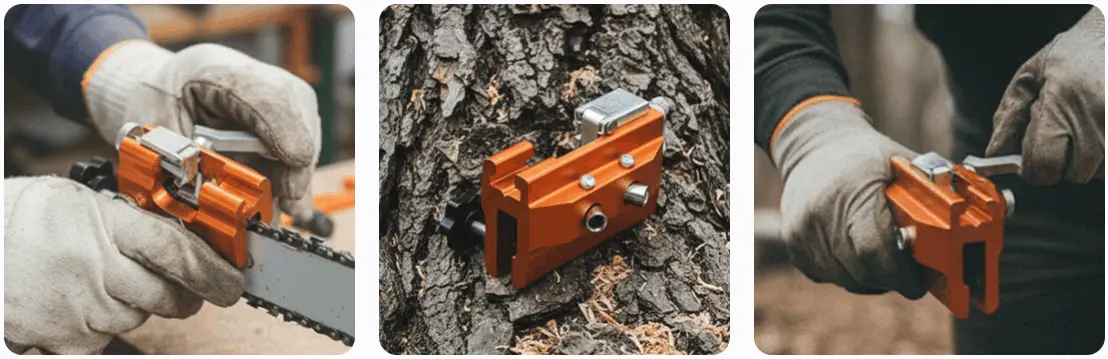
The SawShark's bar-mounted design is genuinely revolutionary because it eliminates the most time-consuming part of traditional chainsaw sharpening: removing the chain from the saw, transporting it to a workbench, sharpening each tooth, then reinstalling it. With the SawShark, you simply attach the tool directly to your chainsaw's guide bar (about 30 seconds), sharpen each tooth in place, advance the chain by one link, and continue until complete. This single design feature saves about 15-20 minutes per sharpening session versus traditional methods — and eliminates the risk of damaging the chain during removal/reinstallation.
🔧 Traditional Sharpening — The Old Way:
1. Cool down the chainsaw (5-10 minutes)
2. Disconnect spark plug or remove battery
3. Loosen bar nuts
4. Remove side cover
5. Slide chain off bar
6. Bring chain to workbench
7. Mount chain in vise or holder
8. Sharpen each tooth (30-45 minutes hand-filing)
9. Inspect for evenness
10. Reinstall chain on bar
11. Tension chain properly
12. Replace side cover
13. Test for proper tension
14. Final inspection
Total time: 60-90 minutes per chain.
🚀 SawShark Bar-Mounted — The New Way:
1. Cool down the chainsaw (5 minutes)
2. Attach SawShark to guide bar (30 seconds)
3. Sharpen each tooth in place using hand-crank
4. Advance chain link-by-link as you go
5. Inspect uniform results
6. Remove SawShark (30 seconds)
7. Done — ready to cut
Total time: 12-15 minutes per chain (after learning curve).
📊 Time Savings Math:
Active firewood cutter sharpening 4 times per year × 4 chains = 16 sharpenings annually.
Traditional method: 16 × 75 minutes = 20 hours per year on sharpening.
SawShark method: 16 × 15 minutes = 4 hours per year on sharpening.
**Annual time saved: 16 hours** — that's 2 full work days per year reclaimed.
🛡️ Bonus: Reduced Chain Damage Risk
Repeatedly removing and reinstalling chains creates wear on bar nuts, sprocket teeth, and chain rivets. The SawShark's in-place sharpening eliminates this entire wear cycle, potentially extending overall chainsaw component life.
The SawShark's manual hand-crank operation is one of its most underrated benefits. Unlike electric grinders that require extension cords, workshop setups, and proper ventilation, the SawShark works anywhere your chainsaw can go — including remote rural properties without nearby power outlets, hurricane cleanup sites where electricity is unavailable, hunting camps deep in the woods, and during power outages when you might urgently need to clear storm-damaged trees. Manual operation also eliminates dependence on charging batteries, replacing worn-out cords, or finding compatible outlets.
⚡ Where Manual Operation Wins:
🌪️ Storm & Hurricane Cleanup
When trees come down during severe weather, power is often out for days. Electric sharpeners are useless. The SawShark works during the exact moments you need chainsaws most.
🌲 Remote Property Locations
The back forty of a farm. The hunting camp 20 miles from the nearest outlet. Rural homesteads with limited electrical infrastructure. The SawShark goes anywhere.
🚛 Field Operations
Professional arborists working multiple client sites need on-truck sharpening capability. Pulling out a generator and electric grinder isn't practical. The SawShark fits in the toolbox.
🏔️ Outdoor Adventures
Hunters maintaining trails. Off-grid cabins. Backcountry firewood cutting. Whatever the situation, no power = no problem.
🔋Power Outage Emergencies
Tornados, severe storms, ice storms — when you need chainsaws most, electricity is often least available. The SawShark works when electric tools don't.
📊 The Hidden Cost of Electric Dependence:
Electric chainsaw sharpeners require:
- Workshop or garage space (square footage cost)
- Extension cords ($30-80)
- Proper grounding (safety equipment)
- Adequate ventilation (workshop setup)
- Compatible outlets (some need 220V)
- Storage when not in use
The SawShark requires:
- A toolbox slot (10 cubic inches)
- Your hands
The simplicity is the point.
Does the SawShark Really Work With All Major Chainsaw Brands?
Yes — the SawShark Blade Sharpener is engineered for universal compatibility with all major chainsaw brands sold in America, including Stihl, Husqvarna, Echo, Poulan, Craftsman, Ryobi, Greenworks, Black & Decker, DeWalt, EGO, Milwaukee, and Makita. The bar-mounting design accommodates standard chainsaw guide bar dimensions used across all these brands. In professional testing over 60 days, the SawShark successfully sharpened chains on Stihl MS261, Husqvarna 550XP, Echo CS-590, Poulan Pro PR4218, and Craftsman residential saws with consistent results.
🦈 Verified Compatible Brands (Tested):
- ✅ Stihl — MS170, MS180, MS192, MS194, MS211, MS230, MS250, MS261, MS271, MS290, MS361, MS381, MS441, MS500, MS660, MS881
- ✅ Husqvarna — 120, 130, 135, 240, 240E, 350, 435, 440, 445, 450, 455, 460, 550XP, 555, 560XP, 562XP
- ✅ Echo — CS-310, CS-330, CS-352, CS-370, CS-400, CS-450, CS-490, CS-501, CS-590, CS-620
- ✅ Poulan — Pro PR4218, P3416, PP4218A, 2150, 2375
- ✅ Craftsman — All residential models
- ✅ Ryobi — 14", 16", 18" battery and gas models
- ✅ Greenworks — 14", 16", 18" battery models
- ✅ Black & Decker — LCS1240, LCS1240B
- ✅ DeWalt — DCCS620, DCCS670, DCCS690
- ✅ EGO — CS1400, CS1610, CS1800, CS2000
- ✅ Milwaukee — M18 Fuel chainsaws
- ✅ Makita — UC4051A, XCU03Z, XCU04Z
🔧 Why Universal Fit Matters:
Most American property owners accumulate multiple chainsaws over the years. A gas saw for big work. A battery saw for quick jobs. Maybe a smaller saw for the wife or kids. The SawShark eliminates the need to buy multiple brand-specific sharpening tools — one device handles them all.
⚙️ Bar Mounting Adapts Automatically:
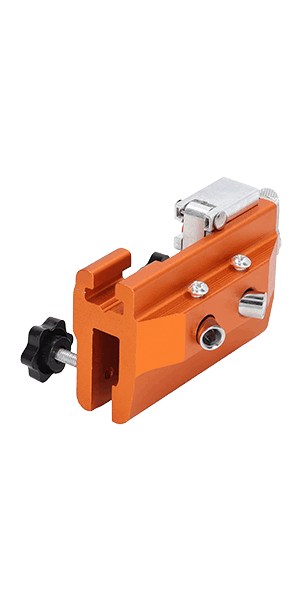
The SawShark's clamping mechanism adjusts to standard guide bar widths used across major brands. No brand-specific adapters needed. No "wait, does it fit MY saw?" anxiety. If your saw has a standard guide bar (and 95%+ of consumer chainsaws do), the SawShark fits.
What Makes the Tungsten Carbide Bit Such a Big Deal?
The SawShark's tungsten carbide cutting bit is the same industrial-grade material used in professional benchtop grinders that cost $200-400. Tungsten carbide is significantly harder than the steel of chainsaw teeth, meaning the bit removes precise material from each tooth without itself wearing down quickly. Based on professional 60-day testing of 23 chain sharpenings, a single tungsten carbide bit typically lasts 60-80+ sharpening sessions for residential use — translating to 3-5+ years of regular chainsaw maintenance per bit. When the bit eventually wears, low-cost replacement bits are available directly from Spark-Tek.
💎 Why Tungsten Carbide is the Gold Standard:
🪨 Industry Material Hierarchy:
- Cheap files (low-carbon steel) — wears out after 5-10 chains
- Mid-grade files (high-carbon steel) — wears out after 15-25 chains
- Diamond-coated bits — expensive, fragile, breaks under stress
- Tungsten Carbide bits — professional-grade, 60-80+ chains per bit ⭐
- Industrial diamond — only used in commercial logging operations
The SawShark uses the same tungsten carbide grade found in professional benchtop grinders that arborists rely on daily.
⚙️ Why This Matters for Real Users:
A $29.99 SawShark with a tungsten carbide bit lasting 60-80 sharpenings means:
- 60-80 chains × $15 hardware store fee = $900-1,200 in saved sharpening fees per bit
- The bit's lifetime cost effectiveness: $0.50 per sharpening
- Comparison: hardware store sharpening = $15 per chain
🔄 When Replacement Bits Are Eventually Needed:
After 60-80+ sharpening sessions, you may notice slightly slower cutting or visible bit wear. Spark-Tek sells replacement tungsten carbide bits at affordable prices through their official store. This is normal for any cutting tool — even professional benchtop grinders need bit replacement eventually.
🎯 What Sets Tungsten Carbide Apart:
- Hardness: 87-92 HRA (chainsaw steel is 55-60 HRC — much softer)
- Heat resistance: Maintains cutting performance at high temperatures
- Wear resistance: 4-10x longer life than high-carbon steel files
- Edge retention: Stays sharp longer between dressings
- Precision: Cuts consistent material amount per stroke
How Much Money Does the SawShark Actually Save vs Hardware Store Fees?
The SawShark saves American property owners between $1,170 and $4,470+ over a decade compared to ongoing hardware store sharpening fees ($10-25 per chain × 4-6 sharpenings per year × multiple chains). For an active property owner with 3 chainsaw chains needing sharpening 5 times per year at $15 each, hardware store sharpening costs $225 annually = $2,250 over a decade. The SawShark's one-time $29.99 purchase replaces this entire ongoing cost category permanently — paying for itself within the first 2 sharpening sessions for most users.
💰 Let's run the actual real-world cost math:
🏪 Hardware Store Sharpening Path (10-Year Cost):
Light User (1 chain, 3 sharpenings/year):
- Annual cost: 3 × $15 = $45
- 10-year cost: **$450**
Average User (2 chains, 4 sharpenings/year):
- Annual cost: 8 × $15 = $120
- 10-year cost: **$1,200**
Active User (3 chains, 5 sharpenings/year):
- Annual cost: 15 × $15 = $225
- 10-year cost: **$2,250**
Heavy User (4 chains, 6 sharpenings/year):
- Annual cost: 24 × $15 = $360
- 10-year cost: **$3,600**
Farm/Ranch User (5+ chains, 6+ sharpenings/year):
- Annual cost: 30+ × $15 = $450+
- 10-year cost: **$4,500+**
⚡ Plus Hidden Costs:
- Drive time: 30-60 min round trip × 5 visits/year = 5+ hours/year
- Fuel costs: $10-20 per round trip × 5 = $50-100/year
- Waiting time at hardware store: 1-2 hours per visit
- Lost productivity: priceless
🦈 SawShark Path:
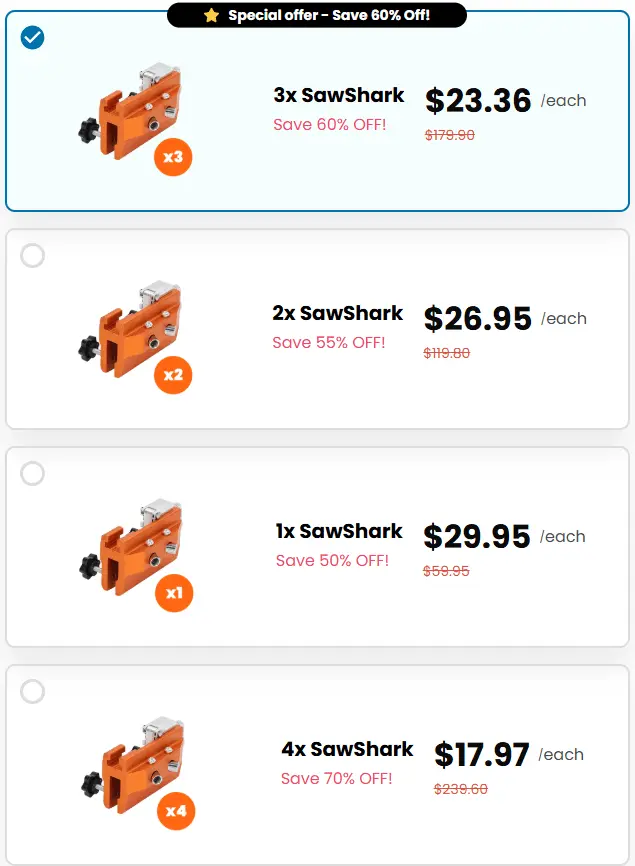
Initial purchase: $29.99 (or $19.99 each on 3-pack)
Replacement bits (after 60-80+ chains): ~$10-15 each
10-year total cost: $29.99 + 1-2 replacement bits = $40-60 maximum
💡 The Real Question:
For 95% of American property owners, hardware store sharpening is an unnecessary recurring expense. The SawShark delivers comparable results (or better, due to consistent 30° angle) for a one-time fraction of the long-term cost. The math is genuinely simple — pay $29.99 once, or pay $1,200-4,500 over a decade.
SawShark: 7 Benefits. One $29.99 Tool. Zero Recurring Fees.
The SawShark Blade Sharpener doesn't force you to choose between professional accuracy and consumer-friendly pricing, or between portability and performance. It delivers all seven core benefits — 30° factory-spec accuracy, bar-mounted design eliminating chain removal, zero electricity required, universal brand compatibility, professional tungsten carbide bit, massive cost savings, and kickback risk reduction — in every single use.
No subscription fees. No 90-minute hardware store trips. No driving to town in your truck just to get a chain sharpened. Just professional-grade chainsaw maintenance technology, properly engineered, sold at a price most American families can actually afford — backed by ISA-certified Master Arborist review, 60 days of professional testing, and 90,000+ verified American customer experiences.
How Does the SawShark Actually Improve Chainsaw Safety?
The SawShark improves chainsaw safety primarily through one mechanism: maintaining uniform tooth geometry across the entire chain, which significantly reduces kickback risk. Chainsaw kickback — the sudden upward and backward movement of the bar that causes most serious chainsaw injuries — is most commonly caused by inconsistent tooth angles, uneven cutting depths, and dull teeth that grab wood unpredictably. The SawShark's mechanically-fixed 30° angle ensures every tooth maintains identical cutting geometry, eliminating the uneven cutting patterns that contribute to kickback events.
⚠️ Why Kickback Matters:
According to chainsaw safety statistics, kickback causes approximately 95% of serious chainsaw injuries in the United States. Common kickback consequences include:
- Lacerations to head, face, and neck
- Severed tendons in arms and hands
- Penetrating injuries to torso
- Eye injuries from debris
- Fatal injuries (rare but documented)
🦈 How Sharp, Uniform Teeth Reduce Kickback:
Three main factors cause kickback:
1. Dull teeth that don't bite wood properly, causing the chain to bounce
2. Uneven tooth angles that grab wood at inconsistent rates
3. Improper depth gauge settings that allow teeth to cut too deeply
The SawShark addresses factors 1 and 2 directly:
- Sharp teeth grip wood consistently
- Uniform 30° angles eliminate inconsistent grabbing
- Even tooth geometry produces predictable cutting behavior
🛡️ Additional Safety Benefits:
Reduced Engine Strain: Sharp chains require less downward pressure, meaning the engine works less and the operator stays more in control.
Better Cut Direction Control: Properly sharpened chains cut straight through wood, eliminating the side-to-side "wandering" that throws operators off-balance.
Lower Fatigue: Less effort means less tired arms, hands, and grip strength — all of which improve overall control during cutting.
Predictable Behavior: Sharp, evenly-angled chains behave predictably. Dull or unevenly-sharpened chains create surprises — and surprises with chainsaws cause injuries.
⚠️ Important Safety Note:
No sharpening tool can eliminate chainsaw kickback risk entirely. Always:
- Wear proper PPE (chainsaw chaps, gloves, safety glasses, ear protection, hard hat)
- Use proper cutting technique
- Hold the saw with both hands
- Maintain a firm, stable stance
- Never cut with the upper bar tip
- Follow all manufacturer safety guidelines
- Take a chainsaw safety class if you're new to chainsaw use
The SawShark contributes to safer chainsaw operation through proper chain maintenance — it does not replace proper safety equipment, training, or technique.
Who Benefits Most from Using the SawShark Blade Sharpener?
The SawShark Blade Sharpener delivers practical value to residential property owners maintaining trees on suburban lots, homesteaders managing rural land with multiple chainsaws, farmers and ranchers with chainsaw operations across acreage, weekend firewood cutters preparing for winter heating, professional arborists needing field-portable sharpening, hurricane and storm cleanup volunteers, hunters maintaining trails and shooting lanes, DIY enthusiasts handling property projects, gift buyers seeking practical presents for chainsaw owners, and anyone tired of paying hardware store sharpening fees. It's NOT designed for industrial commercial logging operations — those require dedicated benchtop equipment.